

A Tiffany lamp can be an antique original or a modern piece inspired by the same stained-glass look. Louis Comfort Tiffany founded Tiffany Studios in New York in 1885, and its iconic stained-glass lampshades followed in the 1890s. Knowing what to check before buying Tiffany lamps means looking beyond the name to the glass, workmanship and evidence of authenticity.
The glow is part of the appeal: coloured glass can bring a gentle warmth and pattern to a room. Yet a beautiful shade alone doesn’t tell you whether a lamp is an original or how its light will feel in your home. This guide covers four useful checks, from glass and construction to placement, authenticity and what auction results can reveal about market value. You’ll have a clearer sense of what you’re looking at, and what matters most before choosing a lamp.
Key Takeaways
- Look closely at the glass and the joins between panels to judge the shade’s materials and workmanship.
- Match the lamp’s pattern, scale and light to its place in the room before choosing a style.
- A Tiffany Studios mark alone doesn’t prove a lamp is an original; consider the shade, base and evidence together.
- Auction results can show how design and rarity influence value, but a single sale doesn’t define every lamp’s worth.
1. 2 · Lighting & placement: what to look out for?
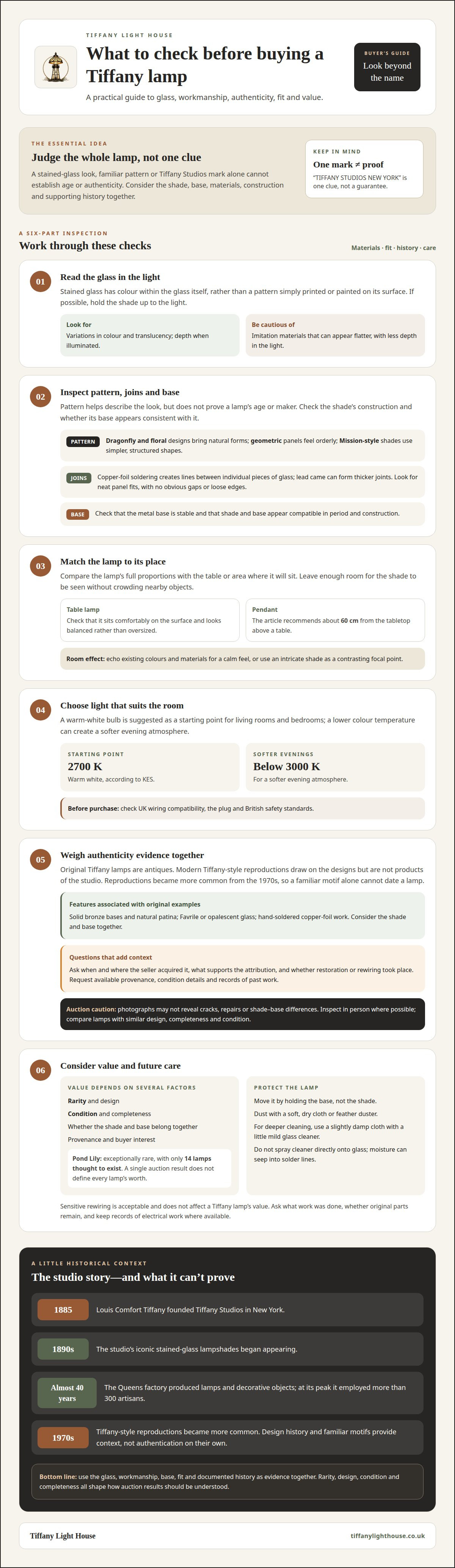
Start with the glass. Stained glass has colour within the glass itself, rather than a pattern simply printed or painted on the surface. If you can, hold the shade up to the light and look for variations in colour and translucency. Imitation materials may appear flatter, with less depth when illuminated.
Look at the pattern and how it will work in your room. Dragonfly and floral designs bring natural forms into the space, while geometric panels create a more orderly feel. Mission-style shades use simpler, structured shapes. A familiar pattern or Louis Comfort Tiffany’s association with the stained-glass tradition does not establish a lamp’s age or authenticity. Consider whether its colours echo your room or make the lamp a focal point.
Examine the joins and the base. Copper-foil soldering creates lines between individual glass pieces, while lead came can make thicker joints. Check that the panels fit neatly, without obvious gaps or loose edges. A stable metal base matters too. Compare the lamp’s proportions with the table or corner where you plan to place it, so the shade looks balanced rather than oversized.
Think about lighting as well as appearance. A warm-white 2700 K bulb is a starting point for living rooms and bedrooms, according to KES. For a softer evening atmosphere, choose a colour temperature below 3000 K. A pendant above a table is recommended at about 60 cm from the tabletop. Check UK wiring compatibility, the plug and British safety standards before purchase.
Think about care as well as appearance. Move a lamp by holding its base, not by putting pressure on the shade. Dust it with a soft, dry cloth or feather duster. For a deeper clean, use a slightly damp cloth with a little mild glass cleaner, and avoid spraying cleaner directly onto the glass, as moisture can seep into solder lines. These checks help you decide what to check before buying Tiffany lamps for your home.
2. 3 · Quality & authenticity: original or Tiffany-style?
Louis Comfort Tiffany founded Tiffany Studios in New York in 1885. Its iconic stained-glass lampshades began appearing in the 1890s. Original Tiffany lamps are antiques; modern Tiffany-style reproductions draw on their designs without being products of the studio. Reproductions became more common from the 1970s, so a familiar pattern alone cannot establish a lamp’s age.
Assess the whole lamp rather than relying on one mark. A Tiffany Studios signature does not, by itself, prove authenticity. Original examples are associated with solid bronze bases and natural patina, Favrile or opalescent glass, and hand-soldered copper-foil work. Check whether the base and shade appear consistent in period and construction. A mismatch may affect authenticity and value. A mark such as “TIFFANY STUDIOS NEW YORK” is one clue, not proof.
Measure your space before choosing a lamp. Note the usable width and height of the surface or area, then compare them with the lamp’s full dimensions. Leave enough room for the shade to be seen without crowding nearby objects. A pendant should suit its position above a table, while a table lamp should sit comfortably on its surface. To create a calm interior, choose a design that echoes existing materials; for a focal point, let an intricate shade add contrast.
Antique value reflects several details together: rarity, design, condition and whether the shade and base belong together. Age alone doesn’t make every Tiffany Light House lamp equally valuable. Tiffany Studios’ Pond Lily design is considered exceptionally rare, with only 14 lamps thought to exist. By contrast, more familiar patterns may have a different level of scarcity. Auction results offer useful context, but compare like with like: design, completeness and condition all shape the result.
For a considered room choice, explore stained-glass lighting designs alongside the features you’ve assessed.
3. Original Tiffany Studios lamps versus modern reproductions
Tiffany Studios artisans made stained-glass lamps from the late nineteenth century into the early twentieth century. Its Queens factory produced lamps and decorative objects for almost 40 years. At its peak, the factory employed more than 300 artisans. Modern Tiffany-style lamps draw inspiration from this tradition, but their resemblance doesn’t make them original studio pieces. Reproductions became more common from the 1970s.
Design history can add context, but it cannot authenticate a lamp on its own. Clara Driscoll and her team of female artisans, known as the Tiffany Girls, conceived designs including the Dragonfly. The motif alone does not prove a shade’s age or maker. Consider the materials, construction and any documented history together, rather than treating a pattern or signature as a complete test.
Rewiring needs careful thought with an antique. Sensitive rewiring is acceptable and does not affect a Tiffany lamp’s value. Ask what electrical work has been done, and whether original parts remain. Keep records of work and preserve removed components where possible. A table lamp with replaced wiring may still be an original, but its condition and alterations matter when documenting its history.
Ask the seller when and where they acquired the lamp, what supports its attribution, and whether any restoration or rewiring took place. Request available provenance, condition details and records of past work, then compare them with the lamp itself.
Photographs may not show cracks, repairs or differences between the shade and base. If you’re considering an auction purchase, inspect the lamp in person where possible. Bidding based only on an attribution can make it easier to miss important details about condition or authenticity.
4. Auction prices and market value
Auction results show how rarity and buyer interest can lift an antique Tiffany lamp’s value, but a headline sale isn’t a guide to every example. Christie’s New York recorded a Tiffany Studios Butterfly table lamp sale on 14 June 2023, and a Fruit table lamp sale on 8 June 2023. Different designs, condition and provenance mean those results shouldn’t be treated as interchangeable.
Compare lamps with similar designs and condition. Note whether the shade and base appear to belong together, the state of the stained glass and any alterations. An authentic bronze base and carefully made shade may support an attribution, but a mark alone does not establish authenticity. Damage or missing parts can also affect interest in a lamp compared with a well-preserved example of the same design.
Look at both estimates and completed sales. An estimate reflects an auction house’s view before bidding; the final result shows what buyers paid for that particular lot. Christie’s offered a Tiffany Studios Bamboo table lamp with an estimate for its 10 June 2026 New York sale. Treat that estimate as a guide to that object and sale, not a fixed value for other lamps.
For UK buyers, compare records in their original currency rather than treating overseas sale figures as direct UK valuations. Auction prices can vary according to design, rarity, condition, documentation and demand at the time. They do not tell you whether a lamp will suit your room or furniture, so consider practical fit separately from investment value.
Before deciding, make a short comparison: record the lamp’s design, condition, provenance, auction estimate and realised result where available. Then weigh those details against your intended use. If you’re choosing for atmosphere rather than collecting, explore stained-glass lighting for a considered fit with your home.
Tiffany Light House: Tiffany Ceiling Lights
Tiffany Light House offers Tiffany Ceiling Lights for rooms where stained-glass colour can become part of the overhead setting. Each shade is handcrafted from individually cut and arranged glass using the traditional copper-foil technique, bringing crafted detail and coloured light into everyday spaces.
For other positions around the home, Tiffany Light House also offers Tiffany Floor Lamps, Tiffany Table Lamps and Tiffany Wall Lights. Consider where you want the light, the room’s existing colours and the space available. A ceiling light can shape the room’s atmosphere, while a table lamp brings colour closer to a reading corner or side table.
Explore the handcrafted lighting at Tiffany Light House online at tiffanylighthouse.co.uk and find a style that suits your home.
Choose a lamp that feels at home
Knowing what to check before buying Tiffany lamps gives you a practical starting point. Picture the lamp in your room at different times of day. Consider whether its colours feel restful beside your favourite chair or whether its pattern adds character to a quieter corner. The right choice should feel at home in your space, not just look impressive in a photograph.
Let comfort and lasting enjoyment guide the final decision. Think about the space you have, the atmosphere you want and how the lamp will fit your everyday routines. If you’d like to explore possibilities with a lighting specialist, contact Tiffany Light House. Take your time, trust your eye and choose a piece that makes your room feel warmly your own.
Frequently Asked Questions
What is a Tiffany lamp, and why is it called that?
A Tiffany lamp is a stained-glass light associated with Louis Comfort Tiffany and Tiffany Studios. The name refers to the designer and studio, rather than guaranteeing a lamp’s age or origin. Tiffany Studios began in New York in 1885, and its lampshades became known in the 1890s. Today, “Tiffany-style” usually describes a modern design inspired by that tradition, not an original studio lamp.
2 · Lighting & placement: what to look out for?
Consider how the lamp will work in the room, not only how its shade looks. A table lamp can add a pool of warm light beside a chair, whilst a pendant can bring colour above a dining table. Compare the lamp’s dimensions with the furniture and available space. For a relaxing atmosphere, KES recommends starting with a 2700 K warm-white bulb in living rooms and bedrooms.
3 · Quality & authenticity: original or Tiffany-style?
An original Tiffany Studios lamp is a historic studio-made object; a Tiffany-style lamp takes inspiration from its appearance. Treat a familiar Dragonfly design or a studio mark as a clue, not a complete identification. Compare the shade and base, look for consistent construction, and consider any documented ownership history. Several matching details give a clearer picture than one feature alone.
Can restoration work affect value?
Restoration can affect how collectors view a lamp, particularly if original glass, metalwork or other parts have been replaced. Sensitive rewiring is acceptable and does not affect a Tiffany lamp’s value. Keep records of any work, including what changed and which original pieces remain. Those details help distinguish electrical updates from alterations to the lamp’s visible craftsmanship.
How important is condition?
Condition matters because cracks, missing glass, loose joints and damaged bases affect both appearance and completeness. Tiffany lamps are around 100 years old, so buyers shouldn’t expect every antique example to be perfect. Look at the shade in good light and check whether repairs are visible. Note each flaw separately, rather than judging the lamp by age or overall impression alone.
How can you tell an authentic Tiffany lamp from a reproduction?
Use several clues together: materials, construction, signature, and whether the shade and base appear to belong to the same period. Original Tiffany Studios lamps are associated with bronze bases and hand-soldered copper-foil work, but no single mark proves authenticity. Compare the seller’s account and available records with the object itself. A Dragonfly motif alone cannot identify its maker.